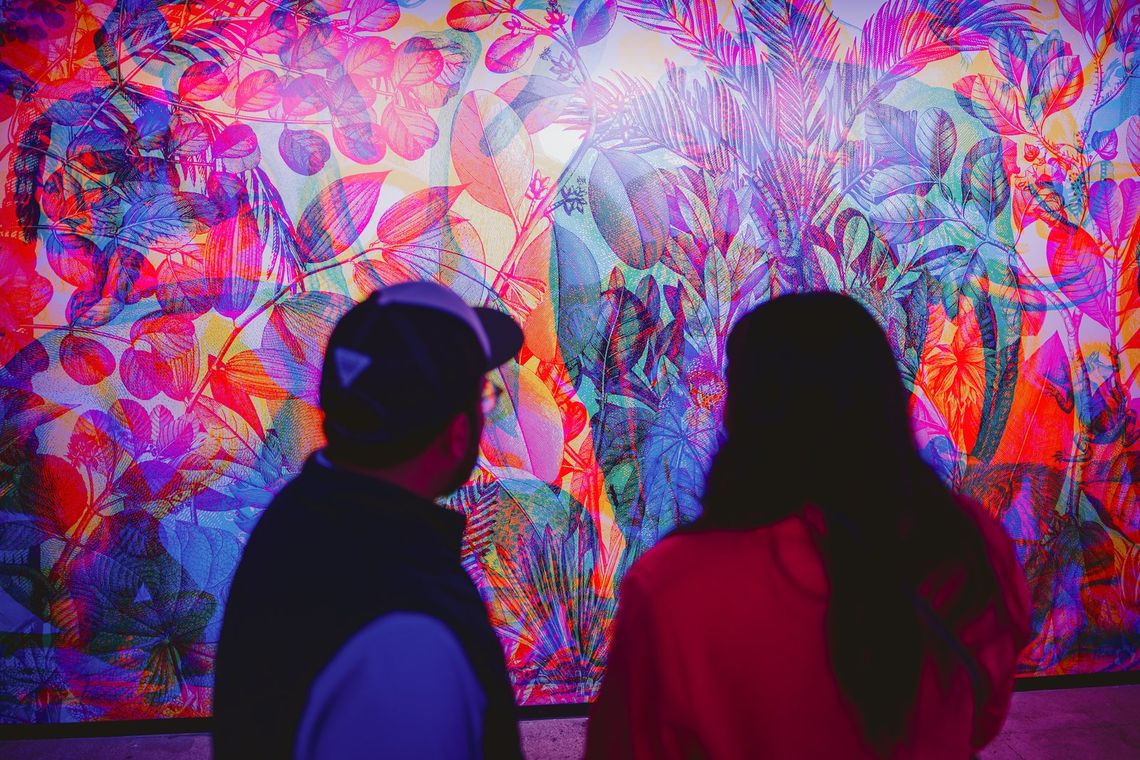
Carnovsky is the shared name of Francesco Rugi and Silvia Quintanilla, an Italian duo who have been making walls change their minds since 2007. Their technique is simple to describe and hard to stop looking at. They layer three separate images, printed in pure red, green, and blue, into one composition. Under white light the layers pile up into a dense, dreamlike montage. Under red light one picture emerges. Under blue, another. Under green, a third. The images were there the whole time, hiding inside each other.
The images hide inside each other.
Rugi was born in Tuscany, studied art history in Bologna, and lived in Verona before settling in Milan, where the two met at Domus Academy in 2004. The work draws on 16th- to 18th-century European natural history engravings, so expect beasts, botany, and anatomy rendered with an engraver's patience. It has been featured in Hi-Fructose, Dezeen, Design Boom, and Wallpaper, turned into a wallpaper line with Jannelli e Volpi, and published as "Illuminature," a children's book for the Victoria and Albert Museum. They have built site-specific versions in London (La Selva, at DreamBags JaguarShoes), in Mons, Belgium (RGB Trattoria), and for the London Design Festival.
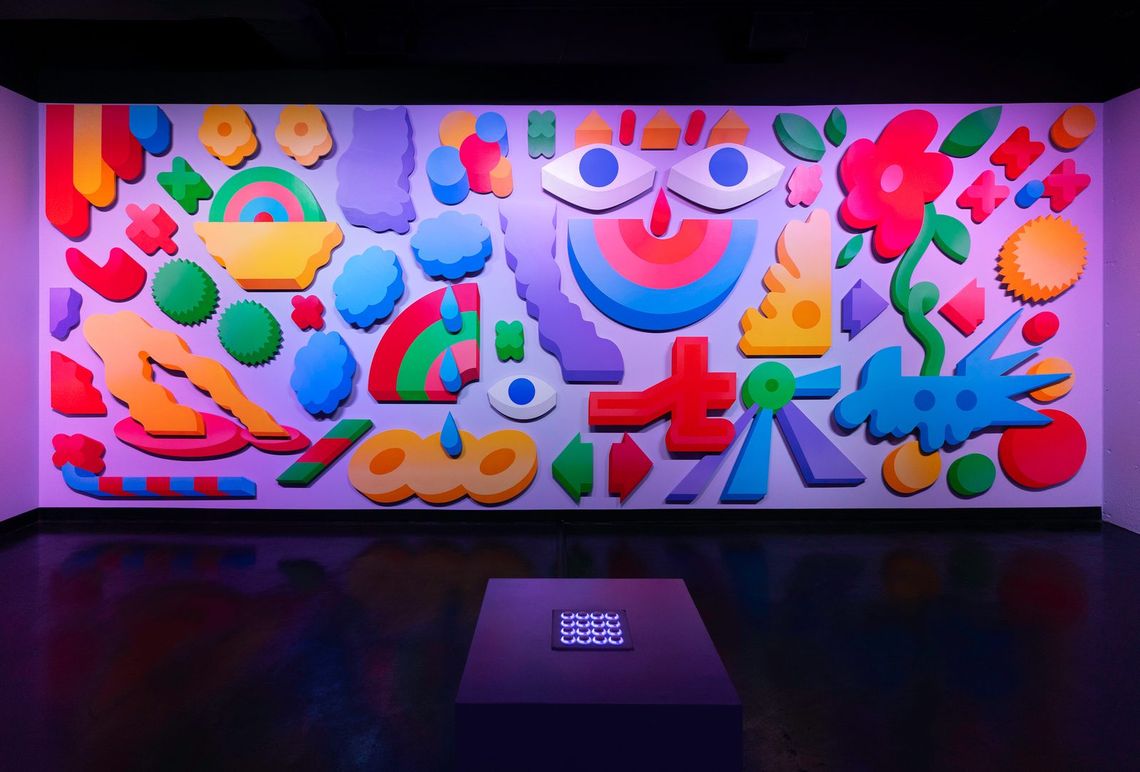
At Hopscotch San Antonio, RGB covers four walls with their illustrations, and the exhibit's lighting does the work of the filters. Walk in and it reads as an impossible collage. Then the light shifts to red and you are looking at one scene. Blue, and it is another. Green, a third. The cycle repeats every few seconds, and most people stand still through several rounds trying to catch the trick. The science is subtractive color: a red-printed image disappears under red light because it matches its background, while the blue and green layers stay visible. A physics lesson that happens to be gorgeous.
The name comes from Philip Roth. In "Zuckerman Unbound," Zuckerman is Roth's alter ego, and Carnovsky is Zuckerman's. An alter ego of an alter ego suits artists whose work is about layers hiding inside layers.