The new work in the Portland featured gallery is made from campfire charcoal, house paint and a studio floor that leans. Caitlin Pashalek on how the Monoliths got here.
Story · PortlandOct 19, 2026
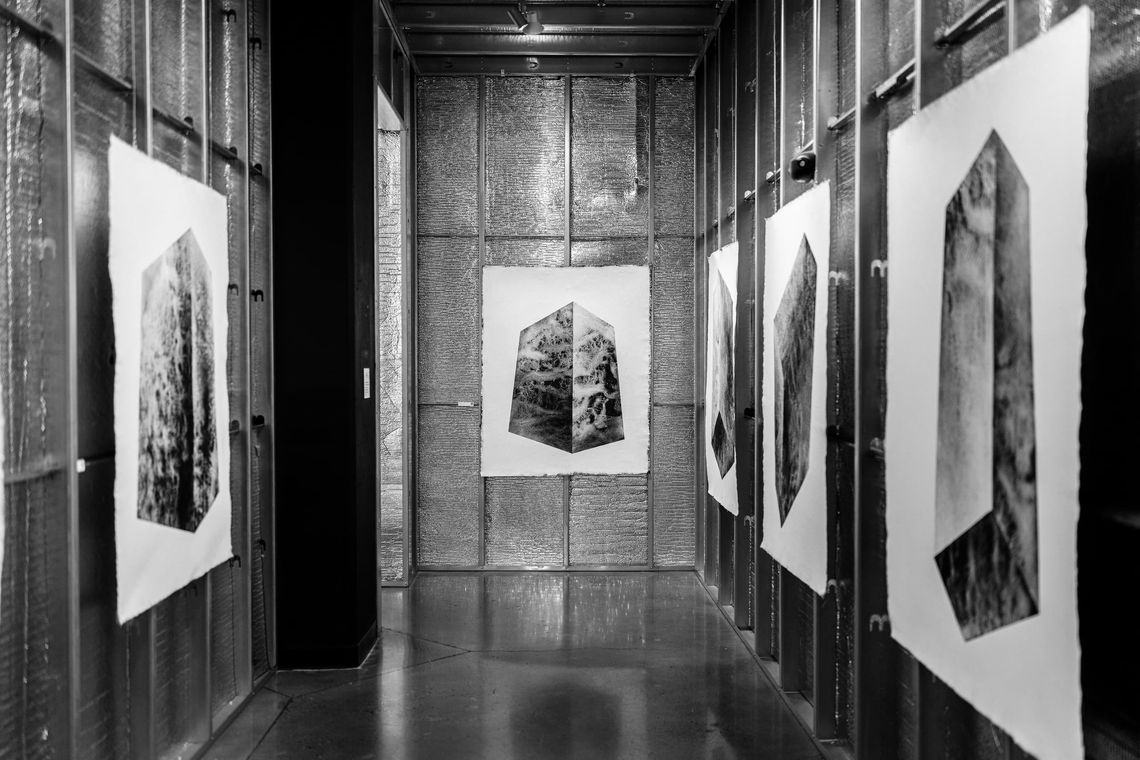
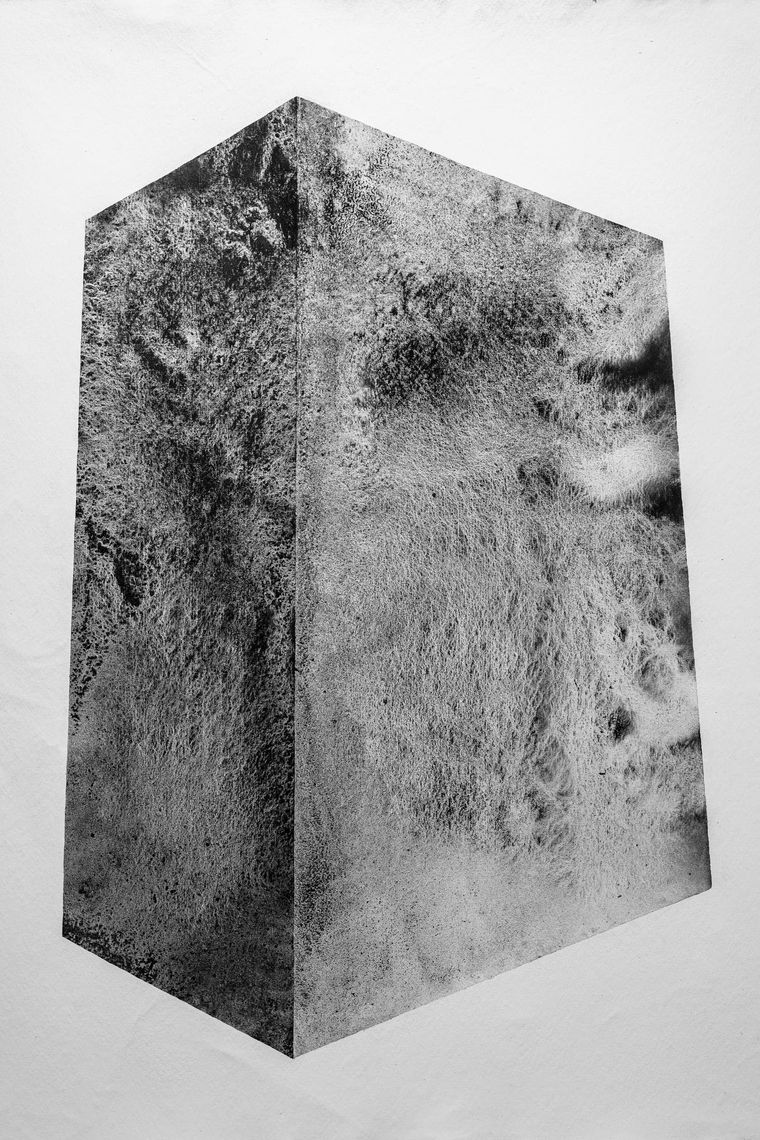
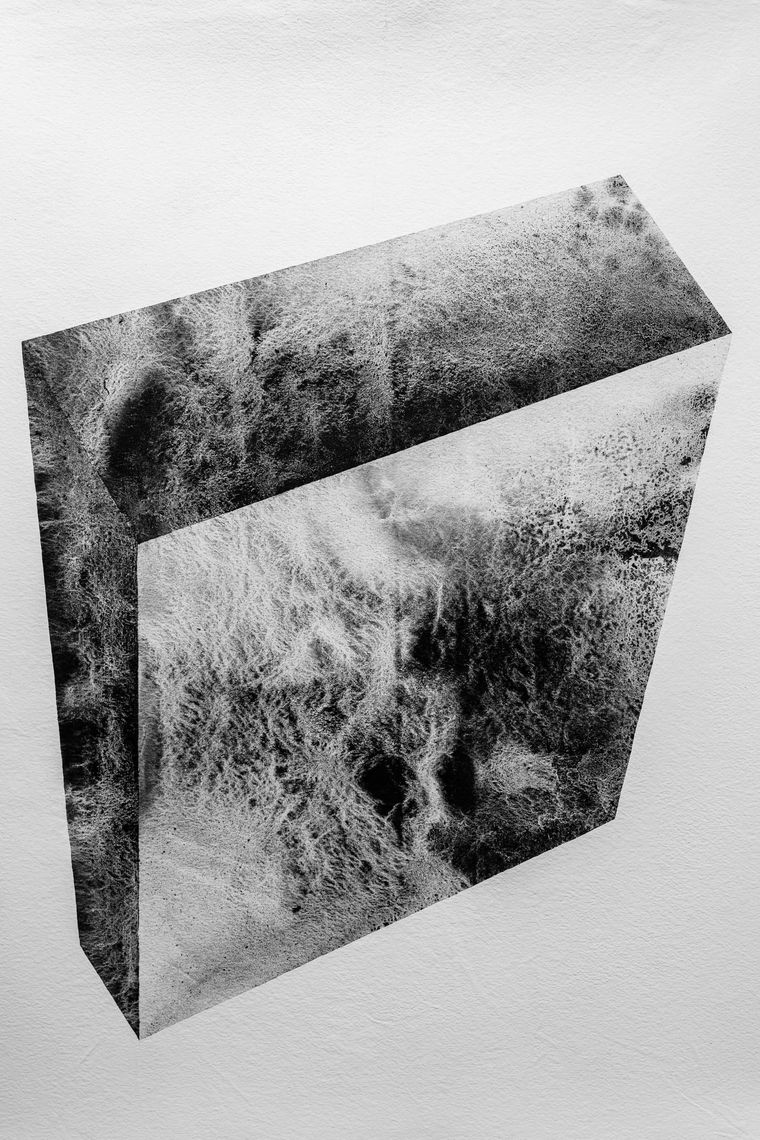
From the end of the hallway they float. Dark, crisp, geometric. Something a very tall species might have left behind. Walk up and they come apart. Dirty edges. Raw canvas. Tiny river deltas where the paint collected and dried. Caitlin Pashalek built the series to be read at both distances, and the walk between them is the point.
She has been calling it Monoliths.
It started with black
“It started with me just being obsessed with ultra black paint,” she says. The most extreme version of a thing. The most matte, the blackest. From there, charcoal. Not from an art store. “I take charcoal from campfires that we have, sift it, and then mix it with water and matte medium.” She has tried the graphite powder you can buy. It does not behave the same way. Her sifter is only so fine, so some pieces come through chunky, and the softer grays tell you where the fine particulate landed. The batch has lived in her studio long enough that the room has what she calls an organic musk.
I take charcoal from campfires that we have, sift it, and then mix it with water and matte medium.
The paint is the easy part to explain. The shapes took longer. Before the Monoliths there were cairns, stacks of stones painted against “everything feeling so precarious right now.” Then collage block towers on the same idea. “It was all just landing too Zen. This is not what I’m trying to say.” She painted them out. “What I actually need is the crispness to counteract the organicness.” Hard geometry on top of a surface that has been fought with. Two streams she had been running separately, finally in one place.
The fights are still in the paintings. Several of these canvases started as failed attempts at the series. She painted over them, and the buildup is what makes the work possible. “The fact that I tried a bunch of things and iterated and wasn’t liking them and painted them out multiple times started the base layer.” The irregular, leathery surface leaves micro nooks for the charcoal to settle into. She has tried the process on a clean canvas. It does not work. The failing is structural.
Closer to weather than to painting
Tape will not hold on a surface this textured, so she masks with tape and then masking fluid, a couple of layers, letting each dry. Flood the whole thing with water. Flood it with charcoal paint. Tip the canvas. “I know which side of my studio slightly leans down. That’s my downhill side. That’ll be my dark side.” Panels dry one at a time. Walking away is the hardest part. “These are also an exercise in patience, to some degree.”
The pieces are the size they are because that is the size of the open space on my studio floor.
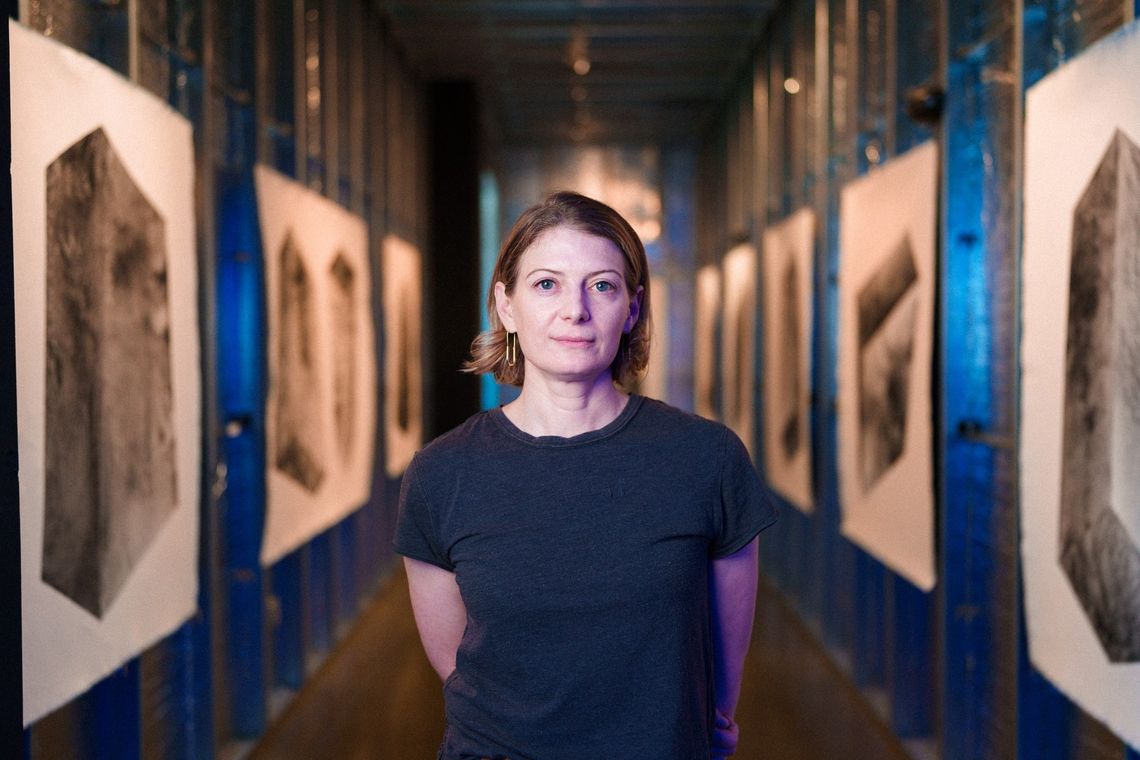
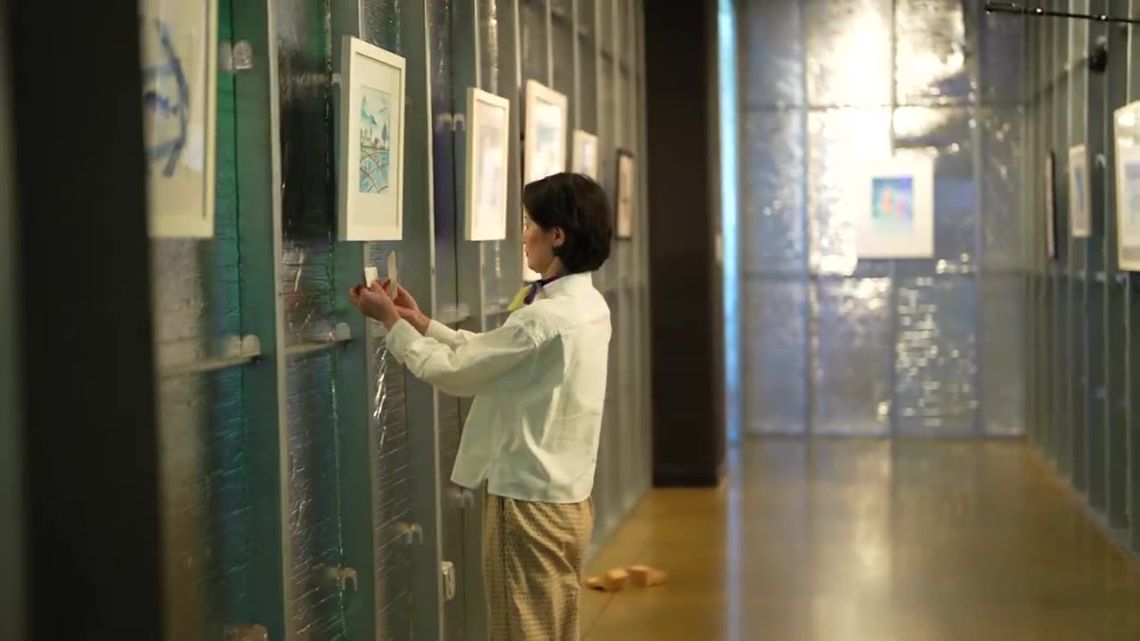
Up close, the charcoal settles into the nooks the failed layers left behind.Crisp geometry over an organic fill. The two streams, finally in one place.Caitlin Pashalek in the featured gallery, Hopscotch Portland, October 2026.
Film school, not art school
She did not go to art school. She went to film school, minored in photography, and her working life has been in film. She does not call herself a painter’s painter. The method is to mess around in the studio until something feels exciting, then chase it. Printmaking, collage, sculpture, a video series of op-art paper sets shot on a phone, all feeding each other. “The garbage from one thing becomes part of the next.” The prints she made for the Hop Shop are not photographs of these paintings. A photo, she says, “is a copy of a thing,” with no material in it. So she cut paper blocks inspired by the series and pulled each print by hand.
Ask her for the tip and you get the one she gives at work. “If you don’t make three things that end up in the garbage, you’re not trying hard enough.” Something should go badly wrong. There may be a kernel of magic in the thing you threw out, and you can take it to the next thing.
If you don’t make three things that end up in the garbage, you’re not trying hard enough.
Two things to know in the hallway
First, a few of these paintings have a failed start on the back. If one of those ends up in your house, you got what she calls a secret bonus painting. Second, most of them hang either way up. She chose up or down based on the rhythm of the group on this wall. Alone, you get to decide. And then change it. “Flip it around randomly to avoid art blindness.” Art blindness is what happens when the thing on your wall stops being visible because you see it every day. Turn it over. New thing.
What does she hope you feel? That it holds up next to everything else in the building. That it is not a downer at the very end. And one more thing. “At a minimum I hope they think, okay, at least it’s something I haven’t seen.”
You haven’t. The Monoliths are in the featured gallery at Hopscotch Portland now.