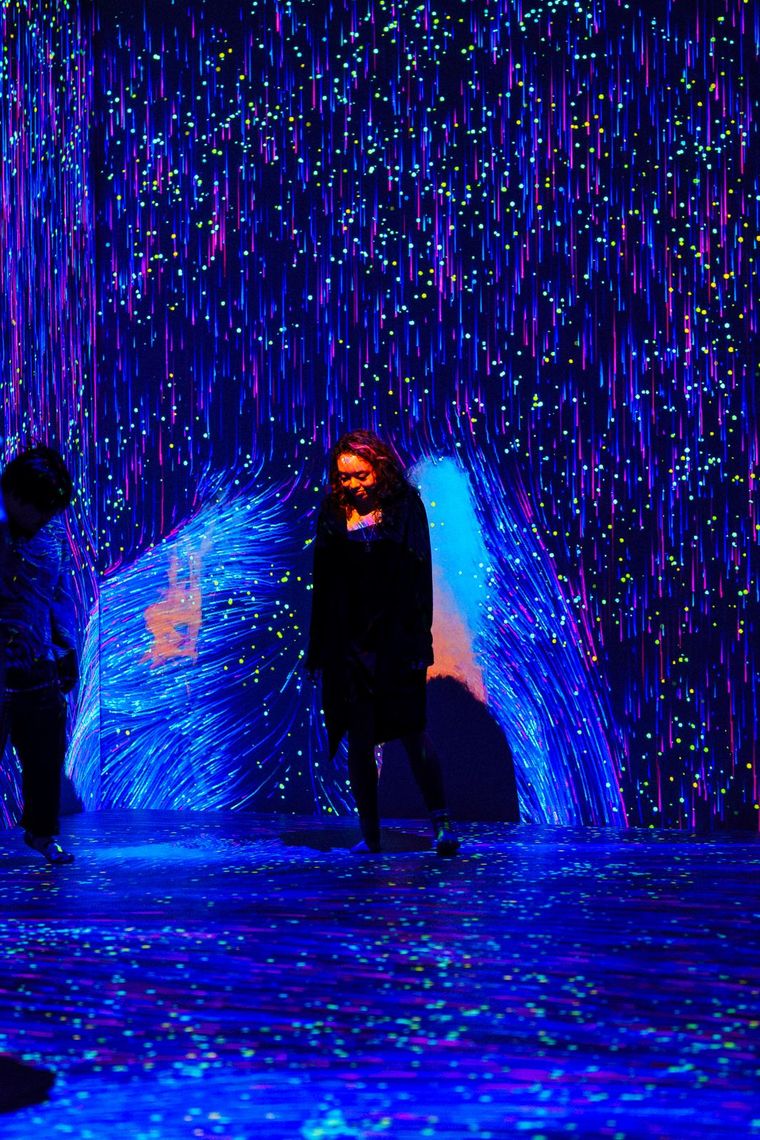
Kuflex is an art studio founded in 2012 by Igor Tatarnikov, Denis Perevalov, and Ksenia Lyashenko, and its exhibits rest on a simple proposition: you are not looking at the art, you are the art's engine. Step onto one of their platforms and your body dissolves into particles of light. Wave an arm and a cloud of pixels follows. Their work sits where technology, science, and art meet, and borrows quantum physics as a loose metaphor: particles, trajectories, infinite space, a human in the middle.
Your body becomes the engine of a tiny cosmos.
The engineering credentials are unusually deep. Perevalov is a computer vision scientist at the Krasovsky Institute of Mathematics and Mechanics in Ekaterinburg. Tatarnikov, who also works as Sodazot, is a video artist, animator, and VJ. Together they wrote the books on openFrameworks, the creative coding toolkit behind much of this field, and they open-source their own tools on GitHub. With more than 200 completed projects, Kuflex has shown at Moscow's Garage Museum of Contemporary Art, the China Science and Technology Museum in Beijing, CES in Las Vegas, and the Athens Digital Arts Festival. Quantum Trampoline is also permanently on view at Ikono Art Gallery in Berlin.
At Hopscotch, Quantum Trampoline, in both San Antonio and Portland, is exactly what it sounds like. You jump, a depth camera reads you, and each bounce sends light particles cascading across the space, following physics that feel half real and half dreamed. Kids go wild. Adults rediscover what it feels like to play without checking who is watching. It is one of the highest-energy exhibits in either city.